The Engine Behind Impact: Why Organisational Development is the Highest ROI
In the social sector, success is often measured in linear terms—beneficiaries reached, lives touched, outcomes achieved. These are essential, but they only reveal the surface. What remains unseen and chronically underfunded is the architecture that makes these outcomes possible.
At Sanjog, our work on advancing equity has shown us that lasting change does not begin with a programme; it begins with the institutional “engine” delivering it.
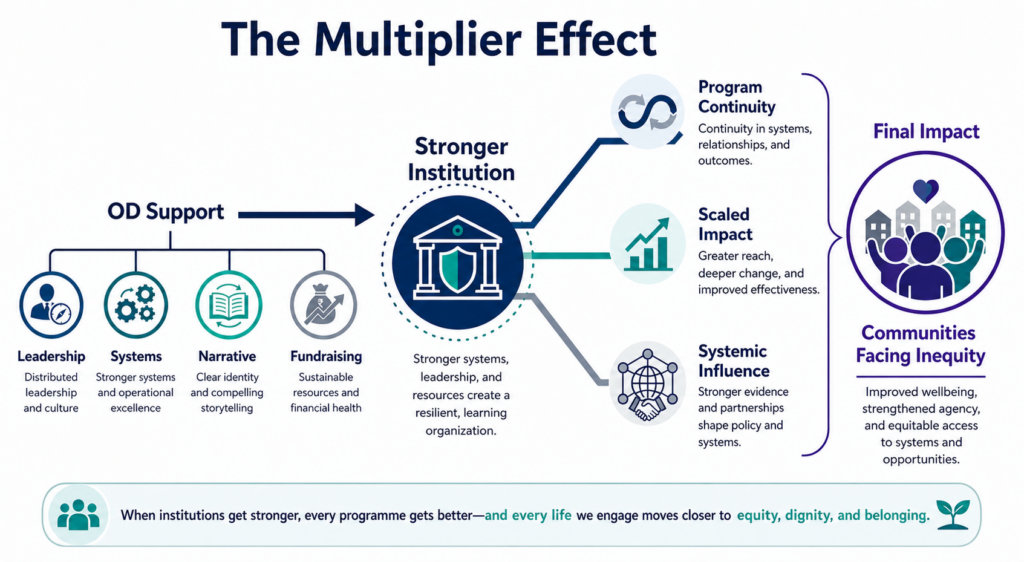
The OD Multiplier Effect
For too long, philanthropy has prioritised direct program costs, trapping many NGOs in what has been described as the “starvation cycle,” where pressure to minimise overheads leads to chronic underinvestment in organisational capacity (Gregory & Howard, 2009). This creates fragility—where even strong programmes are vulnerable when funding shifts.
Organisational Development (OD) offers an alternative: strengthening the core so that all programmes become more consistent, effective, and sustainable.
This creates a multiplier effect:
- For funders, it reduces risk by investing in a stable institutional platform (Bridgespan Group, 2025).
- For organisations, it enables stronger systems, talent retention, and long-term innovation.
- For communities, it ensures more consistent and dignity-centred pathways to equity.
At Sanjog, this approach is not new. Over the past decade, we have strengthened community-based organisations (CBOs), survivor collectives, and grassroots actors to become independent, system-engaging institutions.
This work is rooted in a simple belief: equitable societies require strong, self-determined actors across the ecosystem.
This invites a parallel reflection viz. If ecosystems require multiple strong, interconnected actors, then organisations like ours working to build leadership, generate evidence, and bridge lived experience with systems; must be supported beyond being only programme responders, and strengthened as institutions in their own right.
Turning the Lens Inward
At Sanjog, organisational development is a continuation of this philosophy inward—applying to ourselves the same principles we have long invested in across the ecosystem.
Our Organisational Strengthening & Sustainability Initiative focuses on building coherence between identity, leadership, systems, and sustainability, strengthening our ability to function as a resilient, aligned institution capable of holding complex, long-term equity work.
This includes clarifying our institutional narrative, strengthening distributed leadership beyond the founding layer, building more integrated systems across programmes, research, communications, and fundraising, and investing in structures that allow learning, evidence, and leadership to travel beyond individual projects. It is part of a broader shift toward becoming an organisation that not only delivers programmes, but also generates knowledge, builds leadership ecosystems, and contributes to shaping the field.
This shift has been made possible through visionary funders who have gone beyond programme support, offering flexible funding, strategic accompaniment, and trust. Support from partners including the Nippon Steel Engineering India, EdelGive Foundation, Kamonohashi Project, and Rohini Nilekani Philanthropies has enabled us to begin investing in internal systems, leadership, and long-term sustainability alongside programme delivery.
What Change Looks Like
Even at this stage, the impact of OD prioritisation at Sanjog is palpably visible. Decision-making is evolving toward a more team-centered approach, while remaining anchored in founder experience and guidance. Organisational narrative is becoming more coherent across programmes, and systems for sustainability are beginning to take shape. These shifts are already improving how effectively programmes could contribute to long-term equity outcomes.
Looking ahead, Sanjog envisions evolving into an institution that not only delivers programmes, but builds the conditions for equity, where leadership is distributed, knowledge travels beyond projects, and systems and narratives are influenced to make dignity, participation, and collective power more widely accessible, ultimately enabling deeper and more sustained social impact.
Research supports this possibility: organisations that invest in organisational development are more adaptive and deliver more durable impact over time (Bridgespan Group, 2025; Ford Foundation, 2025).
Reframing the Role of Funders
Evidence shows that when funders invest in organisational strength alongside programmes, nonprofits are more resilient and impactful over time (Bridgespan Group, 2025).
Yet OD funding is still often seen as secondary. The gap is simple: we fund OD at the edges of the ecosystem, but hesitate to fund it at the centre (Bridgespan Group, 2025; Ford Foundation, 2025).
Bridging this gap can take many forms:
- multi-year, flexible funding
- dedicated OD support
- realistic overhead coverage
- technical assistance and peer learning
- trust-based partnerships
These are not add-ons—they are integral to impact, and can be supported with the same clarity, structure, and accountability that funders already apply to programmes.
An Invitation to Partner
If program funding is the fuel, organisational development determines how far that fuel takes us.
Across the sector, there are clear examples where funders who combined programmatic support with institutional investment enabled organisations to stabilise leadership, diversify funding pipelines, strengthen systems, and deepen long-term impact. Initiatives such as the Ford Foundation’s BUILD program and the Bridgespan Group’s Pay-What-It-Takes approach have demonstrated how flexible, long-term funding strengthens organisational resilience and effectiveness. In India, efforts such as the EdelGive Foundation’s GROW programme, along with partnerships across philanthropic and corporate funders, have similarly shown how investing in institutional capacity alongside programmes leads to more sustained and scalable impact.
Through our work with survivor collectives and CBOs, we have seen how investments in leadership and systems translate into independent, self-sustaining actors influencing change beyond programme boundaries. This is the kind of impact we are working to build as an organisation too.
Because when you strengthen the engine, the entire journey, for the organisation, the funder, and the communities at the centre, moves closer to sustained equity.
Sanjog is keen to connect with those who believe this, that impact is not only delivered, but enabled; that sustainability is not incidental, but designed; and that institutions, like communities, require intentional investment to build a more equitable world.
References & Further Reading (APA Style)
- Bridgespan Group. (2025). Pay-What-It-Takes India initiative: Strengthening nonprofit capacity through flexible funding.
- Ford Foundation. (2025). Evaluation of the BUILD initiative: Organisational strengthening and long-term impact.
- Gregory, A. G., & Howard, D. (2009). The nonprofit starvation cycle. Stanford Social Innovation Review.
- Funding for Good. (2023). Nonprofit sustainability and capacity building insights.
- Giving Compass. (2022). Understanding nonprofit overhead and why it matters.
- IDR (India Development Review). (2023). Why nonprofits need core funding and organisational support.
- Open Collective Foundation. (2022). Trust-based philanthropy practices