
Overview
For survivors of human trafficking, gender-based violence, bonded labour, and violence against children, the path to justice is rarely simple, blocked by stigma, hard-to-navigate legal systems, compensation that never arrives, and institutions that exist in name but not in practice.
Sanjog’s Access To Justice work addresses this gap, bringing together survivor support, collective leadership, research, and engagement with institutions to build systems where justice is not just promised, but within reach.
This work emerges from long-term engagement with interstate trafficking cases, where survivors often fall through gaps between police systems, compensation structures, and state-level coordination mechanisms. It has been shaped by initiatives such as Tafteesh, which highlighted critical gaps in justice responses to trafficking and violence, as well as by partnerships with survivor collectives such as ILFAT, where lived experience informs advocacy, accountability, and systems change.
For Sanjog, Access to Justice is not an afterthought. It is central to accountability, systemic change, and the longer work of building dignity and equity for survivors.
What Can Be Done
Survivor Leadership and Rights-Based Justice
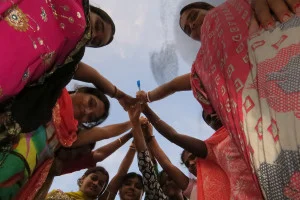
Survivors must be recognised as rights-holders, not just beneficiaries. Compensation must be a legal entitlement, not something granted at discretion. When survivors organise collectively and engage directly with institutions, justice systems are pushed to respond not through charity, but through accountability and rights.
Institutional Accountability and Systems Strengthening
Justice mechanisms ; AHTUs, Legal Services Authorities, and police systems, are only as effective as the consistency with which they are held to account. This requires consistent, long-term engagement with institutions by following up cases, accompanying survivors through legal processes, and documenting where the system fails. Over time, this builds into patterns that expose structural failures and push institutions to genuinely reform.
Evidence, Research, and Coalition
Without evidence, systemic failures stay hidden, and without people working together, even the best evidence goes nowhere. Research, survivor experiences, case records, and information gathered through RTIs help show where systems are failing and why change is needed. But that change becomes possible only when survivor collectives, lawyers, researchers, grassroots organisations, social workers, and prosecutors work together, building shared systems rather than isolated responses.
Why is it Important
When survivors cannot access compensation, legal support, or institutional protection, trafficking networks face little consequence. Survivors spend years navigating systems that were never built for them, compensation delayed, rescues slowed by poor coordination between states, and prosecutions too weak to hold traffickers accountable. Communities lose trust. And violence quietly becomes normal.
When justice is accessible, survivors begin to build lives on their own terms, institutions respond to trafficking with greater accountability, and prosecutions carry enough weight to matter.
The change is social too. Survivors move from silence into leadership and public voice. And when their experiences, backed by evidence and advocacy, consistently reach policy spaces,institutions are pushed to stay accountable.
How Does Sanjog Do This
We work at the level of the survivor and at the level of the system, simultaneously. Sanjog approaches justice not only as legal support for individual survivors, but as long-term work toward changing how institutions respond to trafficking and violence.
Raahat
Raahat is Sanjog’s Access To Justice initiative, built around survivors, and focused on making compensation, legal support, and accountability genuinely reachable.
What makes Raahat different from a standard legal aid programme is not just what it does, but how it is built. Raahat moves beyond case-based support by bringing together civil society organisations, lawyers, grassroots actors, and survivor collectives including ILFAT, whose members bring lived experience and insider knowledge into how the work is designed, understood, and advocated for.These actors work together not just to provide services, but to strengthen the systems and institutions through which survivors access justice.
Through fellowship and leadership development, Raahat supports survivors to move from accessing justice to shaping it, building the collective voice and institutional presence that makes change last.Over time, Raahat works toward a shift from isolation to collective agency, where lived experience becomes a foundation for leadership, advocacy, and lasting change.
AHTU Watch
AHTUs are often the first institutional point responsible for coordinating anti-trafficking responses,yet many remain under-resourced, inactive, or poorly integrated into larger justice systems. When AHTUs fail to function, the cost is borne directly by survivors: compensation goes unclaimed, cases go uncoordinated, and accountability for traffickers weakens. AHTU Watch exists because this dysfunction cannot remain invisible.
AHTU Watch looks at whether Anti-Human Trafficking Units (AHTUs) are actually functioning in practice , whether they have the staff, resources, training, and systems needed to respond to trafficking cases effectively. By bringing attention to gaps within anti-trafficking systems, the initiative aims to strengthen accountability and ensure that survivors seeking justice are not ignored or made invisible because institutions fail to function properly.
The initiative works to:
- Understand how Anti-Human Trafficking Units are functioning across different states
- Highlight gaps and challenges within anti-trafficking response systems
- Strengthen awareness around the role and functioning of AHTUs
- Build conversations with policymakers, civil society organisations, legal actors, and government stakeholders
- Encourage more coordinated, accountable, and effective anti-trafficking systems for survivors seeking justice

Tafteesh
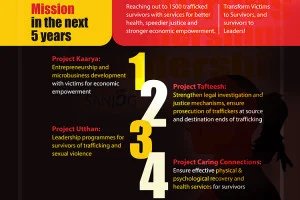
A consortium-based coalition of survivors, lawyers, social workers, probation officers, psychologists, sociologists, researchers, investigation and rescue specialists, and human rights activists, Tafteesh aims to strengthen the systems of justice delivery to survivors of human trafficking.
Read MorePartnerships




Features

Stories of Change
Everyday Heroes
Everyday Heroes, a series of graphic novels, were based on stories of change elicited from
Opinion
2016 - Kolkata Gives
In February 2016, Sanjog was invited to be a part of Kolkata Gives – a one